 English
 Magyar

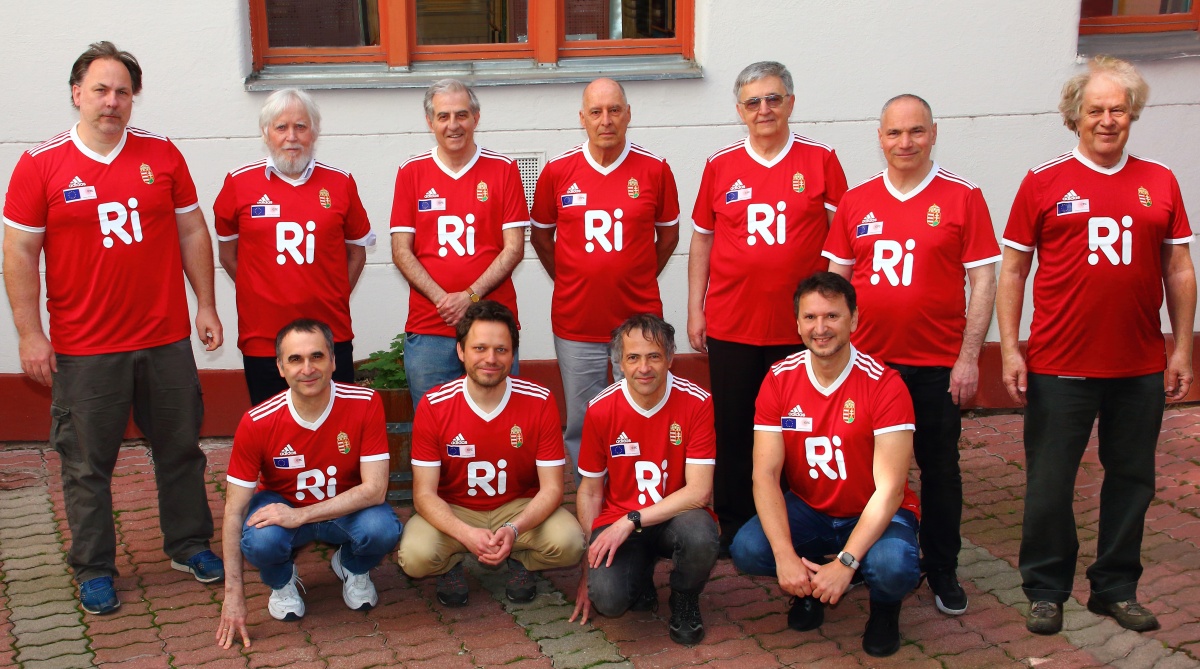
The driving force of mathematical research in Hungary and the main organizer of the 68th International Mathematical Olympiad is the Alfréd Rényi Institute of Mathematics. What makes the Rényi Institute suitable for these roles? A broad and diverse research structure, combined with internationally recognized scientific achievements.
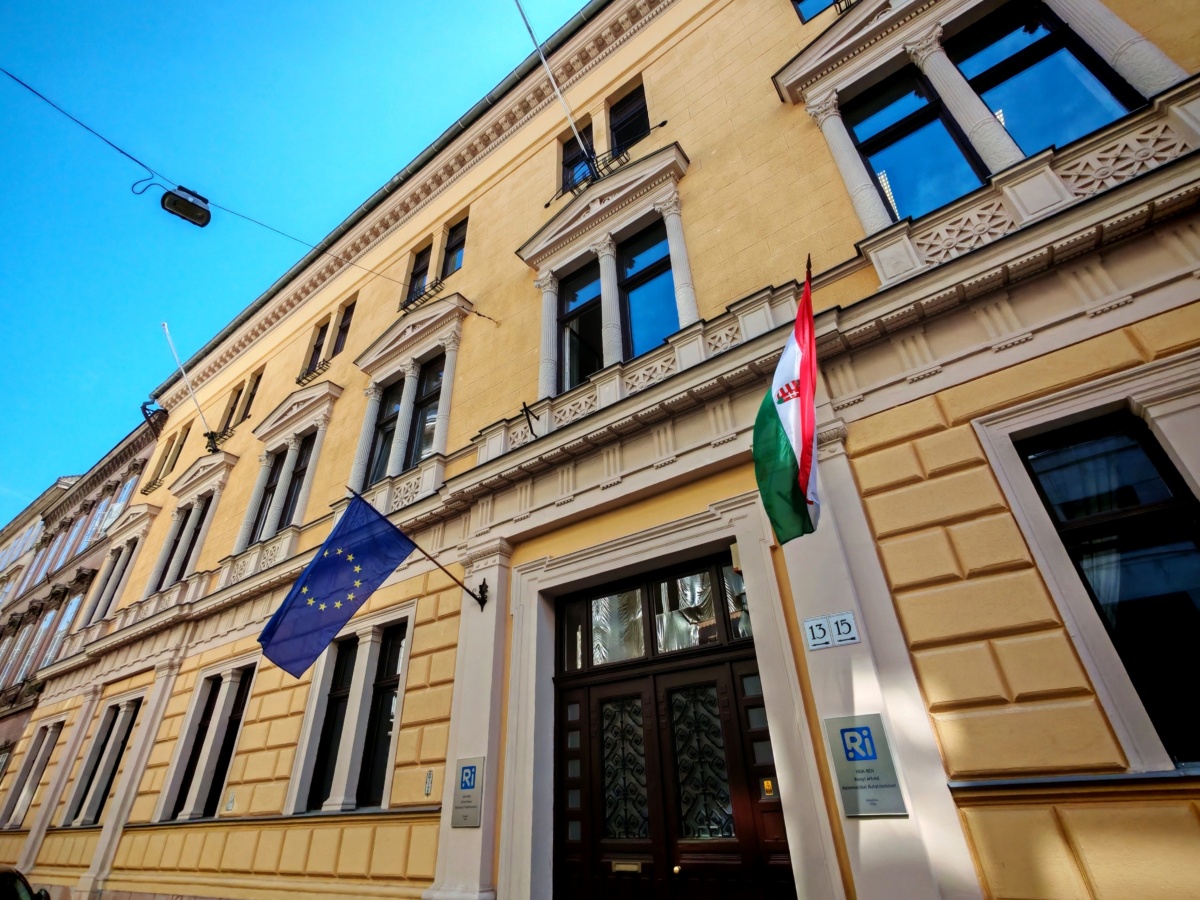
The Rényi Institute has been operating since 1950 and is named after its first director, Alfréd Rényi. As an applied research institute of the Hungarian Academy of Sciences, it employs approximately 120 mathematicians who work in research groups and departments. What are the topics around which these departments are organized? The following list provides an overview.
Algebra
The department’s earlier research topics included semigroup theory, universal algebra, lattice theory, radical theory, and category theory. László Rédei, a former member, made lasting contributions in these areas. Contemporary research is led by Mátyás Domokos, focusing mainly on group theory and ring theory.
Algebraic Geometry and Differential Topology
In the department led by András Némethi, two main research areas are studied: differentiable manifolds and their invariants, and the local theory of complex algebraic/analytic manifolds and singularities. These two areas are connected by the problem of singularity links, creating shared research goals.
Analysis
The analysis department, led by Máté Matolcsi, studies approximation and interpolation theory, as well as extremal problems related to multivariable polynomials and the application of geometric methods in complex and multivariable constructive function theory. This is complemented by applications of potential theory and Fourier analysis in geometry, number theory, combinatorics, and operator theory.
Erdős Center
The Erdős Center organizes interdisciplinary thematic semesters to address current mathematical problems. Under the leadership of Károly Böröczky Jr., the department deals with topics such as the theory of large networks, analytic number theory, low-dimensional topology, probability theory, statistical physics, and the theory of complex manifolds.
Extremal Combinatorics
The department led by Attila Sali focuses on extremal problems of finite hypergraphs, partially ordered sets, vector spaces over finite fields, and graphs. Key topics include Turán-type theorems and Sperner-type problems and their generalizations.
Geometry
Led by Géza Tóth, this department specializes in convex and discrete geometry. In addition to approximation of convex bodies and properties of lattices, they study packings, coverings, graphs, and hypergraphs on finite point sets, as well as intersection numbers, drawings, and other representations of graphs.
Graph Theory
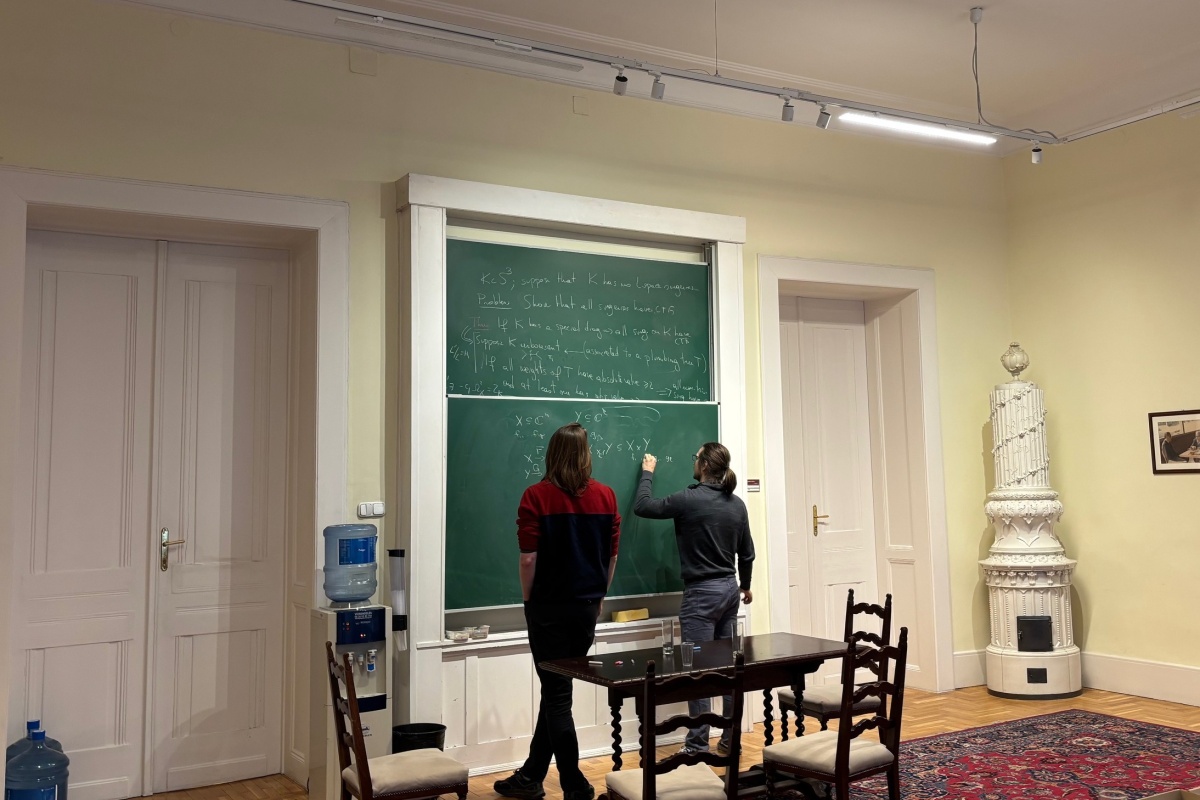
In the department of Balázs Keszegh, colorings, extremal problems, and Ramsey-type questions are central. Research also includes planarity and embeddability on surfaces, as well as graph-like structures such as directed graphs, hypergraphs, ordered graphs, random graphs, and geometrically defined graphs.
Set Theory, Logic, and Topology
The continuation of Hungary’s long-standing tradition in set theory research is led by Lajos Soukup. Following the work of Pál Erdős and András Hajnal, the department focuses on infinite combinatorics; influenced by Miklós Laczkovich, on descriptive set theory; and, following Hajnal Andréka and István Németi, on the foundations of special and general relativity.
Combinatorics and Its Applications
Led by Balázs Patkós, this is one of the institute’s youngest departments. Its main topics are often centered around open problems appearing in research programs, including graph limit theory, network theory, and algorithms on random graphs.
Artificial Intelligence
A highly relevant and contemporary field, led by Balázs Szegedy. The department aims to ensure practical applicability alongside strong theoretical foundations and carefully designed experiments.
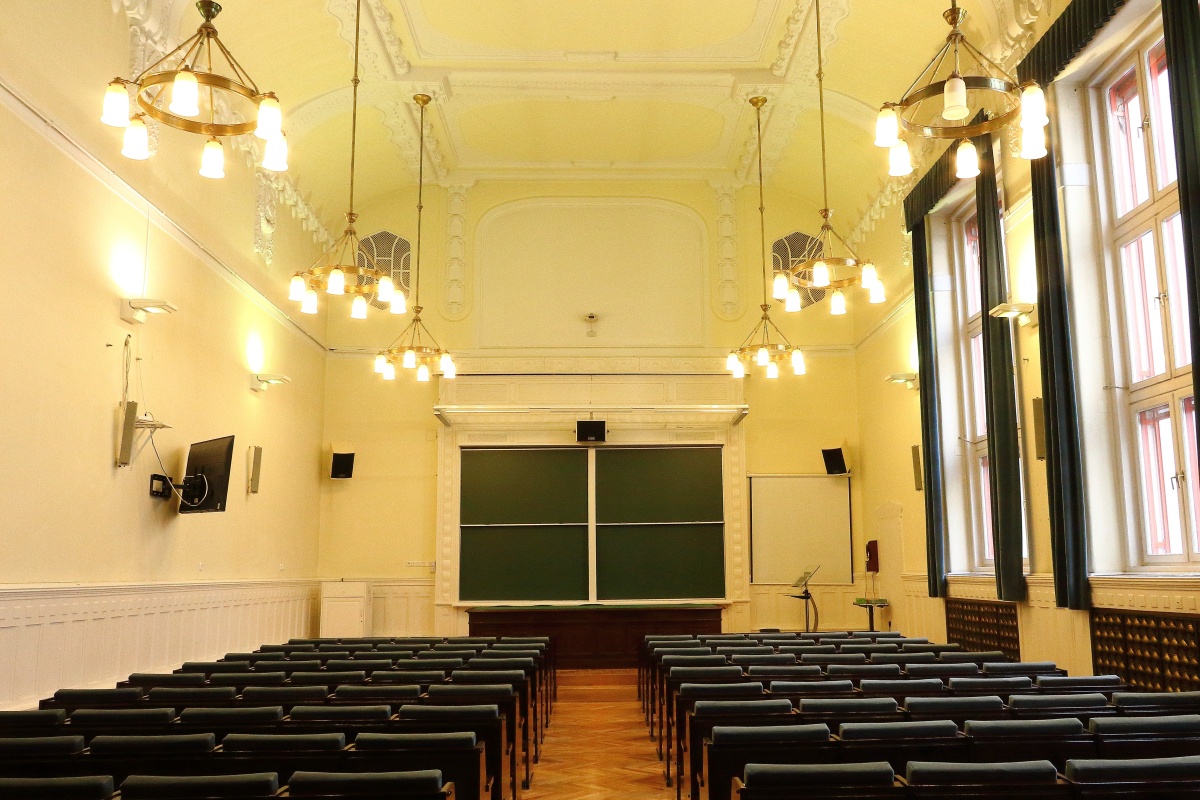
Methodology
How should mathematics be taught? This question is addressed by the department of Péter Juhász. Its members work on extending the method developed by Lajos Pósa, focusing on discovery-based mathematics education and its promotion, as well as how to disseminate these methods among teachers.
Number Theory
The department has two main areas: analytic number theory and additive combinatorics. The former focuses on approximations to the Goldbach conjecture and the twin prime conjecture, as well as the theory of automorphic forms and automorphic L-functions. The latter examines the size and structure of sumsets and difference sets, under the leadership of András Biró.
Probability Theory and Statistics
Led by Miklós Rásonyi, the department conducts research in three main directions. Statistical physics includes percolation theory and diffusive behavior. Random graphs and randomized algorithms include Metropolis methods, consensus models, and various machine learning schemes. Financial mathematics describes the theory of optimal investments.
Behind the broad scientific spectrum stand outstanding achievements. Between 2008 and 2022, eleven researchers from the Rényi Institute won grants from the European Research Council (ERC). Within the European Union’s largest funding system for frontier research, they received grants worth several million euros, awarded solely based on scientific excellence. The Advanced Grant, Consolidator Grant, and Synergy Grant all demonstrate that the scientific standard of the Rényi Institute is first-rate even at European level.