
 English
 Magyar
The concept of the logo
When creating the symbolism of the logo, two aspects were given special emphasis: it should represent the host country of the event, Hungary, and it should also contain a mathematical reference. This is why the choice fell on the Gömböc, the creation of two Hungarian researchers, Gábor Domokos and Péter Várkonyi.
The logo presents this unique geometric form in a simplified way, while the other elements of the visual identity are built around the same formal language. The youthful and playful use of colours speaks to the secondary-school age group of the event, while the shape simultaneously refers to Hungary, mathematics, and the Gömböc’s special equilibrium property.
The primary logo is the main visual identifier of the event. The primary logo contains the full official
name of the event: “68th International Mathematical Olympiad – Budapest 2027”. The logo may only be used in a horizontal layout and only in its original, full-colour version. A Hungarian-language version of the primary logo is also available, using the same typographic and compositional system.
The secondary logo strengthens the visual presence of the event, especially in repeated applications or in contexts where the logo appears in large numbers. The secondary logo contains the abbreviated name of the event: “IMO 2027”. It may be used in both its full-colour and monochrome versions.
The Gömböc
What is the connection between the shell of an Indian star tortoise and the roly-poly toy from our carefree childhood? What is the secret and the challenge behind the concept we commonly call “stability”? And what could all this have to do with a Hungarian mathematician studying the geometry of pebbles on the island of Rhodes?
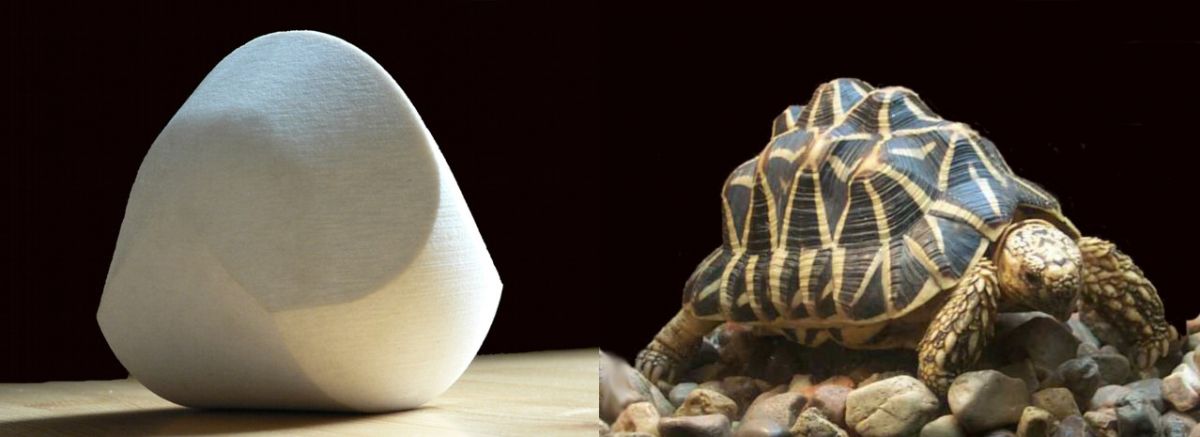
The answer to these questions is the result of a research story spanning more than a decade. The solution is the famous Gömböc: the geometric body that also inspired the logo of the 68th International Mathematical Olympiad.
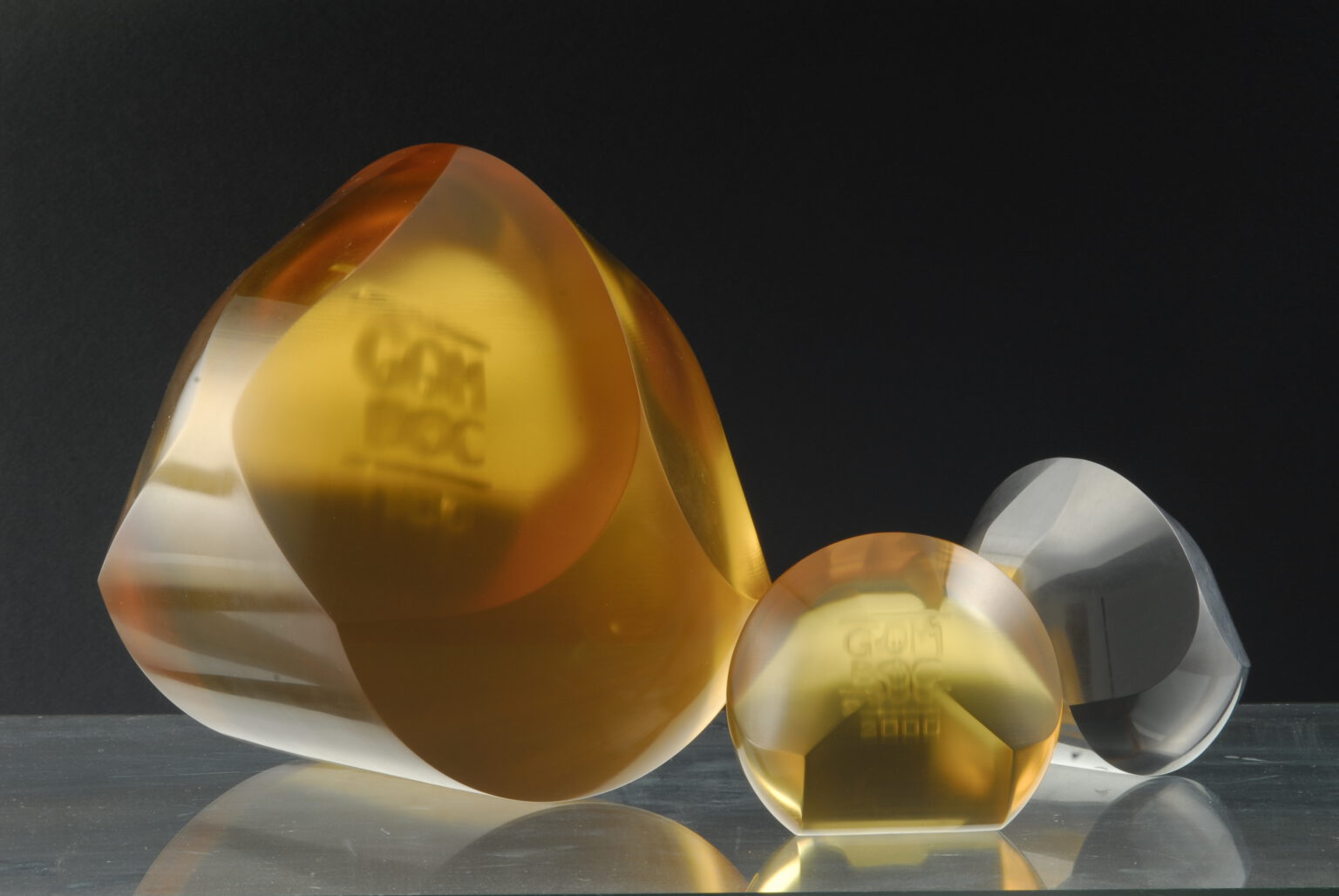
The Gömböc is a three-dimensional, convex and homogeneous body with exactly one stable and one unstable equilibrium position. In other words, unless it is balanced precisely on its unstable point, it returns by itself to its single stable position. In this respect it resembles a roly-poly toy or the self-righting motion of certain tortoises, but unlike them, the Gömböc has a homogeneous material distribution and a convex shape. This is exactly what makes it special among mono-monostatic bodies.
The story begins with a conjecture made in 1995 by the Russian mathematician Vladimir Igorevich Arnold. In the plane, it is known that no homogeneous, convex shape can have only one stable and one unstable equilibrium position. Arnold, however, considered it possible that such a body could nevertheless exist in three-dimensional space. This was the idea he shared with the Hungarian mathematician Gábor Domokos.
In the planar case, the impossibility of a Gömböc-type shape is related to the four-vertex theorem and can be formulated as an equivalent mechanical statement. According to the classical four-vertex theorem, the curvature of a simple, closed, smooth plane curve has at least four local extrema. In the Gömböc problem, the corresponding statement is that a homogeneous, convex planar body — provided its equilibrium positions are non-degenerate — has at least four equilibrium positions.
Take a homogeneous, convex planar shape, and place a polar coordinate system at its centre of mass. Let \(R(\alpha)\) denote the distance of the boundary of the shape from the centre of mass in the direction \(\alpha\). The non-degenerate stable and unstable equilibrium positions correspond to the local minima and local maxima of the function \(R(\alpha)\), respectively.
Assume, for contradiction, that there exists a homogeneous, convex planar shape with exactly one stable and one unstable equilibrium position. This would mean that the function \(R(\alpha)\) has exactly one local minimum and one local maximum. In this case, one could choose a horizontal level \(R=R_0\) on the graph of the function that divides the regions where \(R>R_0\) and \(R<R_0\) into two direction intervals, each of length \(\pi\).
In the original planar shape, this would correspond to a straight line passing through the centre of mass. The line would divide the shape into a “slim” part, where \(R<R_0\), and a “fat” part, where \(R>R_0\). However, if the shape is homogeneous and convex, then, due to the mass distribution of the fatter side, the centre of mass would have to lie not on the separating line itself, but on the fatter side. This contradicts the fact that the line passes through the centre of mass.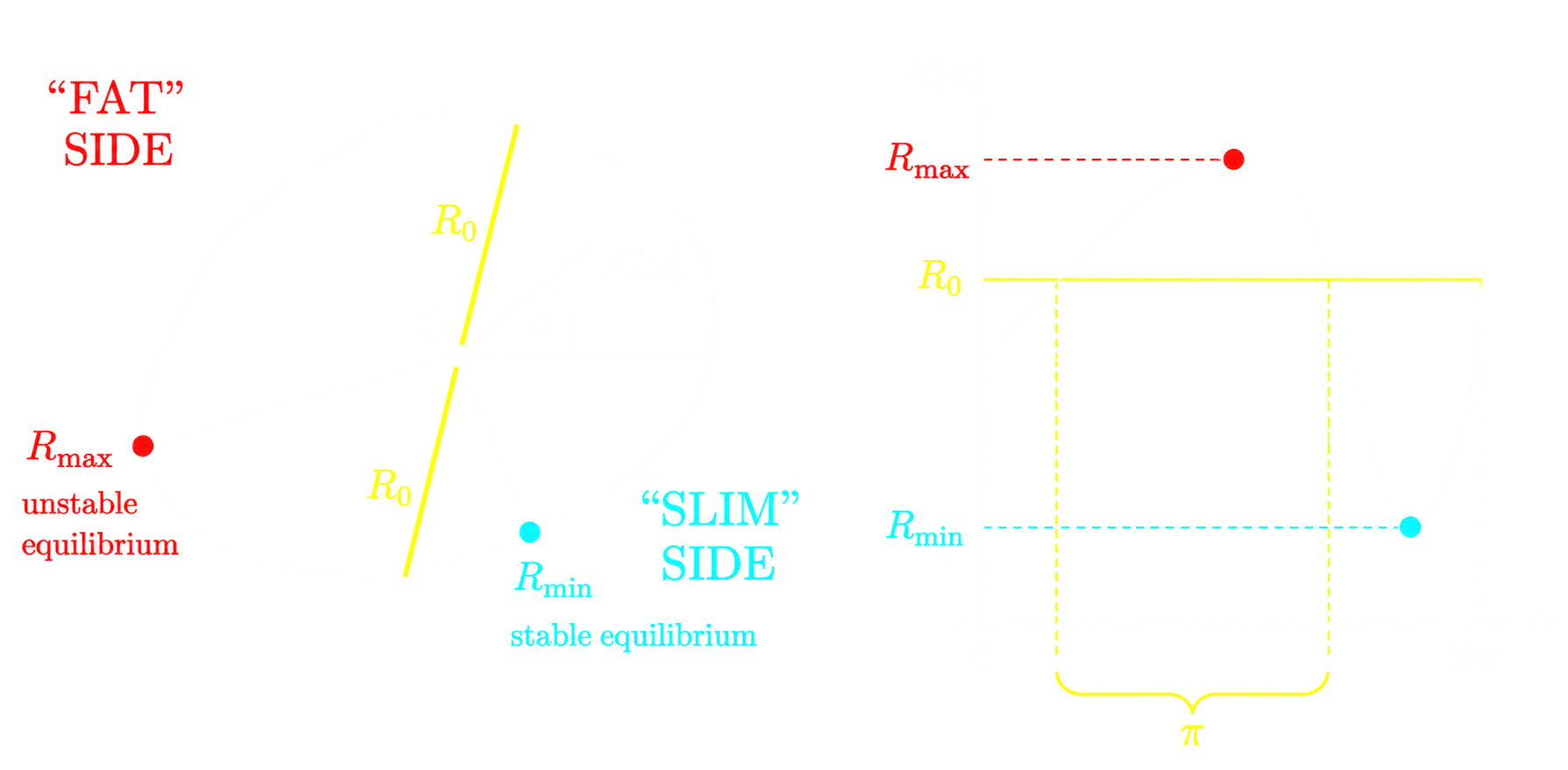
Therefore, no homogeneous, convex planar shape can have exactly one stable and one unstable equilibrium position. In other words, there is no Gömböc-type body in the plane; in the non-degenerate case, at least two stable and two unstable positions — that is, at least four equilibrium positions in total — are necessary.
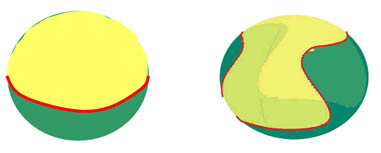
In the three-dimensional case, however, the planar proof no longer works. A spatial body can be described in a similar way by a function \(R(\varphi,\theta)\), but here the level curve \(R=R_0\) separating the slim and fat parts is not necessarily a plane curve. It may, for example, be a space curve similar to the seam of a tennis ball. For this reason, separating the surface of the body does not force the position of the centre of mass into the same contradiction as in the plane. This insight opened the way to the theoretical possibility of the three-dimensional Gömböc.
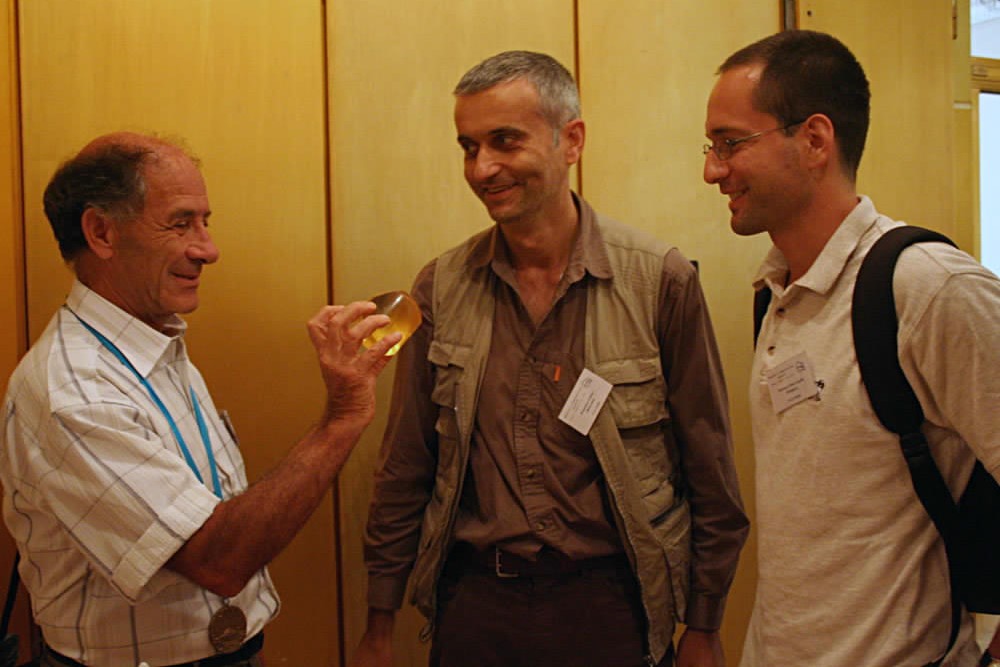
Gábor Domokos also drew inspiration from studying pebbles shaped by the sea. On the island of Rhodes, he examined around two thousand pebbles, but did not find a single shape that satisfied the requirements of the Gömböc. At the same time, the research helped establish a classification of shapes according to the number of their equilibrium positions, and strengthened the conjecture that the key to success could be a geometry very close to a sphere — neither flat nor slim.
With the help of his former doctoral student Péter Várkonyi, Domokos finally proved mathematically in 2006 that a convex, homogeneous, mono-monostatic body can exist. This was the theoretical birth of the Gömböc. The next major step was its physical realisation: they had to create a tangible body that would preserve this extremely sensitive equilibrium property in reality as well.

One tangible difficulty with the first theoretical construction was that, to the naked eye, its shape was almost indistinguishable from a sphere — gömb in Hungarian. This sphere-like appearance also played a role in the name Gömböc, but it also demanded extraordinary precision in manufacturing. Domokos and Várkonyi therefore chose a new approach: later Gömböc forms were built from simple surface elements, such as cylindrical, ellipsoidal and conical surfaces, as well as planes.
The initial question in 1995 was whether a body similar to the Gömböc could exist at all. Today we know that the Gömböc is not a single shape, but can be created in infinitely many different geometries. From a theoretical point of view, these all belong to the same class, but their stability and motion can differ strikingly.
Nothing illustrates this better than the natural parallel of the Gömböc. The high, domed shell of the Indian star tortoise approximates a shape that helps the animal return from an overturned position to a stable posture. The tortoise is, of course, not a Gömböc in the mathematical sense, but the geometry of its shell nevertheless points to the same deep idea: form itself can create stability.
When you are in Budapest, don’t miss the giant Gömböc sculpture on Corvin Promenade: visit it and take a selfie with it!